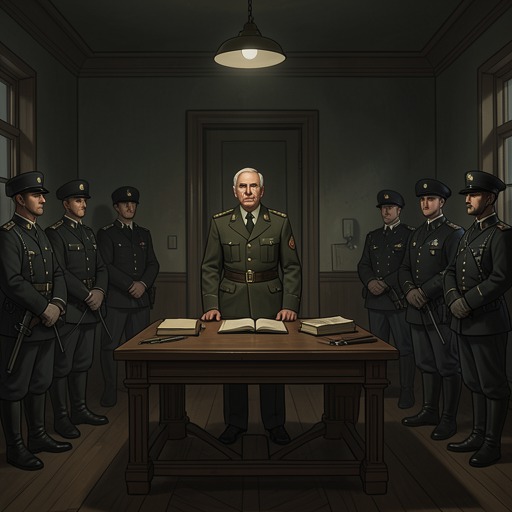
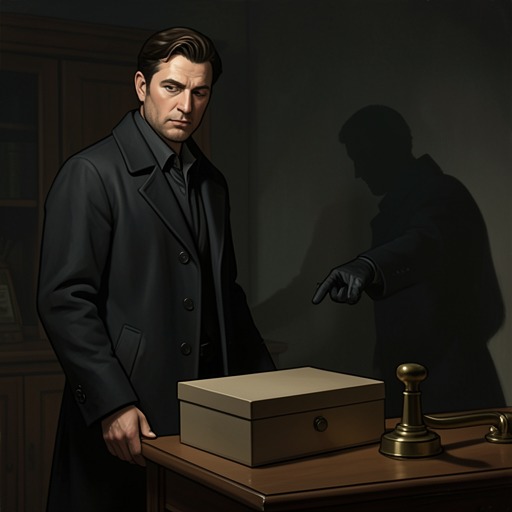
Maximilian von Schwartzkoppen
An Officer and a SpyMaximilian von Schwartzkoppen is the German military attaché at the center of a paper trail that French intelligence repeatedly intercepts, reconstructs, and tries to interpret. His correspondence points toward an unknown source of military information, but it also contains private traces that resist the neat separation of official espionage from personal life. In Georges Picquart’s account, Schwartzkoppen is often encountered not in person but through torn letters, coded references, and scraps whose meaning remains uncertain.
Identity and Intelligence Context
Schwartzkoppen serves as German military attaché, a position that places him within the surveillance orbit of the Statistical Section. In June 1893, the Section acquired a note showing that he had received plans of the fortifications at Toul, Reims, Langres, and Neufchâteau from an unidentified informant. An intercepted note in January 1894 recorded an advance payment of six hundred francs for further plans, including those of Albertville, Briançon, and Mézières, as well as new embankments along the Moselle and Meurthe. The documents establish a channel of military information reaching him, but do not identify its source.
That uncertainty persists in a warning passed through François Guénée. In March 1894, the Spanish military attaché, the marquis de Val Carlos, told Guénée that a German agent on the French General Staff was keeping the German attachés well informed. When Picquart later met the marquis, he heard that an officer associated with the Second Department had supplied information to both the German and Italian military attachés. The marquis could not name the officer. The warning intensified surveillance, but it did not itself establish that Schwartzkoppen knew the informant’s identity.
Correspondence and Private Life
The surveillance archive preserves evidence of Schwartzkoppen’s private correspondence as well as his official contacts. His letters were torn into fragments about the size of fingernails, but Hubert-Joseph Henry and Captain Lauth painstakingly pieced them together with narrow strips of transparent adhesive paper. The repairs left the documents stiff and oddly textured. Written in French rather than German, the fragments contained repeated endearments and declarations of affection. Henry identified their writer as a married woman with whom Schwartzkoppen was having an affair; the surviving account does not name her.
A separately reconstructed petit bleu prompts another uncertain identification. Its message asks for a fuller written explanation of a matter in hand and says that the writer will then decide whether to continue an association with the house of R. When Picquart examines the card, he asks whether its initial C refers to Schwartzkoppen. The question is raised but not answered in the passage, so the card cannot be treated as proof that Schwartzkoppen wrote or received it.
The Informant Question and the Dossier
A later search through intelligence files adds a different name to the problem of the unknown source. Among notes from Alessandro Panizzardi to Schwartzkoppen, Picquart finds a reference to having seen M. Dubois. That name recalls a note dated 27 October 1894, signed by Dubois, offering Schwartzkoppen the secret of smokeless powder. A second note proposed supplying a Lebel rifle cartridge for analysis, though Picquart considers the offer unremarkable: such a cartridge could readily be obtained in a garrison town.
Following a cross-reference in the archive, Picquart locates an April 1894 report by Henry about an agent identified as D, suspected of supplying the Germans and Italians with plans. Henry had named the man as Jacques Dubois, a printer working for a factory handling War Ministry contracts. His report said that Dubois lacked access to classified material, that the plans he provided were publicly available, and that no further action was necessary. The files therefore contain both an apparent connection between Dubois and Schwartzkoppen and an assessment that the suspected source had no access to secrets. They do not, on the evidence presented here, establish that Dubois was the source of the classified plans recorded in the earlier notes.
Narrative Significance
Schwartzkoppen’s place in the account is defined by the gap between intercepted evidence and settled knowledge. Payments and fortification plans indicate that information reached him; affectionate letters disclose an affair; and references to Dubois invite the reader to follow a clue through an archive whose classifications and cross-references shape what can be known. Yet the suspected informant remains uncertain, and the petit bleu’s initial remains an open question. Schwartzkoppen thus appears both as a recipient of military intelligence and as a figure reconstructed through documents whose fragments offer clues without making every conclusion secure.